

How B2B Manufacturers Can Win the Amazon Buy Box
- Daniel Waldman
- Mar 17
- 4 min read

Amazon is one of the largest marketplaces on the planet, now accounting for nearly 40 percent of all U.S.-based Ecommerce. Competition is inherent in the marketplace model, where multiple sellers come together on the same platform and compete for buyers’ business. Compare it to a farmer’s market or a mall; Amazon is the same concept on a significantly grander scale. The idea is that sellers compete on value and customer experience to win the sale. Value, of course, is somewhat subjective, and may or may not be price-based; instead, it’s based on the buyer’s needs.
With more than two million sellers on the platform, it is inevitable to have multiple listings for the same products. To mitigate any customer confusion, and to surface the best value for the customer, Amazon invented the Buy Box. Designed to match the most qualified seller to the buyer’s needs, the Buy Box is algorithmically driven and incredibly competitive, and the seller that wins the Buy Box captures the vast majority of the sales on that product.
Winning the Amazon Buy Box is therefore an essential aspect of selling on Amazon, and Amazon provides sellers with tools to continuously prove they are the best option for the buyer. Let’s take a closer look at what the Buy Box is and what B2B manufacturers can do to ensure they win it.
What Is the Amazon Buy Box?
The Buy Box is the section of an Amazon product page that contains the primary purchase action. It displays the price, shipping method, estimated delivery time, the seller's name, and the "Add to Cart" and/or "Buy Now" button. It is, in short, where the transaction happens.

The Buy Box is a part of the product listing page. A product may have many sellers offering the same item, and each of those sellers is competing to appear as the seller in the Buy Box. That’s called “winning the Buy Box.”
So what does it look like when a brand doesn’t work to control the Buy Box? Take Milwaukee Tools as an example. If you search for a Milwaukee drill on Amazon, you'll find a single product page. But behind that page, there may be dozens of sellers offering that same drill. Only one of them wins the Buy Box, and that seller is identified in the "Sold by" field. The others are listed further down the page under "Other Sellers on Amazon."
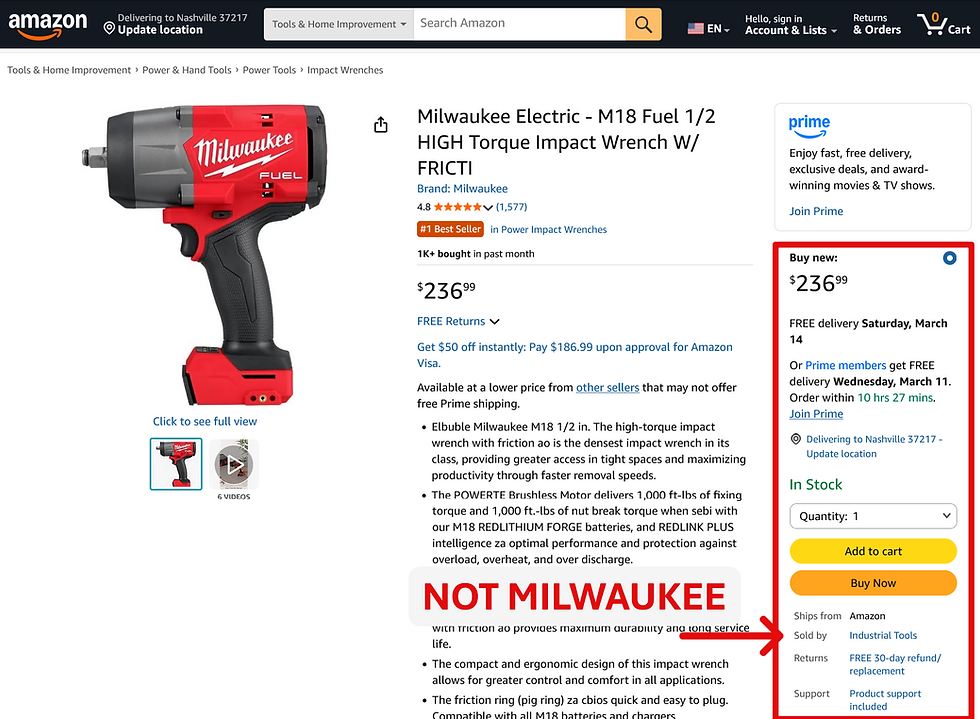
In the case in the image above, there are actually more than 60 sellers competing to win the Buy Box!
This is where many manufacturers get tripped up. Having a branded storefront on Amazon does not guarantee you'll win the Buy Box on your own products. Resellers, many of whom are small and opportunistic, can list your products and compete for that position, often winning the Buy Box by offering the lowest price. This is the cause of price erosion in many cases. Some will also create storefronts designed to look like your brand, which can confuse customers and dilute your brand equity. It happens more than most manufacturers realize. We dare you to search your brand and send us the results.
This is why proactive brand management on the platform is one of the most important things a B2B manufacturer can do in order to protect their brand image, revenues, and profits.
How to Win the Amazon Buy Box
Winning the Buy Box comes down to understanding a handful of key criteria that Amazon's algorithm weighs on a continuous basis.
Price is often the first thing sellers think about, and while it's an important factor, it's not the only one. Overall seller performance and account health matter just as much. Amazon tracks metrics like order defect rate (which, ideally, should be under one percent), late shipment rate (ideally under four percent), and order cancellation rate (ideally under two percent).
Fulfillment method is another major factor, and many sellers rely on Fulfillment by Amazon (FBA) to make their products Prime-eligible, giving them a significant leg up in the algorithm. For B2B manufacturers specifically, configuring your listings for Amazon Business can also improve your Buy Box win rate, as it signals to Amazon that you're set up to serve business buyers effectively.
To compete for the Buy Box, you first have to be in the game. That means a few non-negotiables:
Sell your own products on Amazon, either as a first-party seller (1P) through Amazon Vendor Central, or as a third-party seller (3P) through Seller Central. If you're not actively selling your products directly through one of these methods, you can't win the Buy Box.
Register your brand through Amazon Brand Registry. This gives you greater control over your product listings and access to tools that help protect your brand from abuse.
Build a proactive channel control program. This means establishing and enforcing Minimum Advertised Price (MAP) policies and managing your authorized seller network, both on and off Amazon. Uncontrolled reseller activity is one of the biggest reasons manufacturers lose the Buy Box on their own products.
Manufacturers that struggle on Amazon typically treat it as a passive channel, listing their products and hoping for the best. That, or they ignore the channel all together, as in the Milwaukee example above.
The reality is that without a proactive approach to channel control, you're leaving the door open for resellers to undercut your pricing, win the Buy Box on your own products, and potentially misrepresent your brand in the process. Winning the Buy Box requires an active, ongoing commitment to managing your presence on the platform, and the brands that do it well treat it like any other critical sales channel.
Are your products struggling to win the Buy Box? We can help! Contact our Amazon specialists to discuss your challenges and how Enceiba can help you have a more productive and profitable Amazon presence!


